
At the Stellar Meridian conference, Anthony Scaramucci told banks to kill the iPod in their business.
Scaramucci urges tokenizing top 10 US stocks to prove blockchain value, citing regulation and adoption momentum.
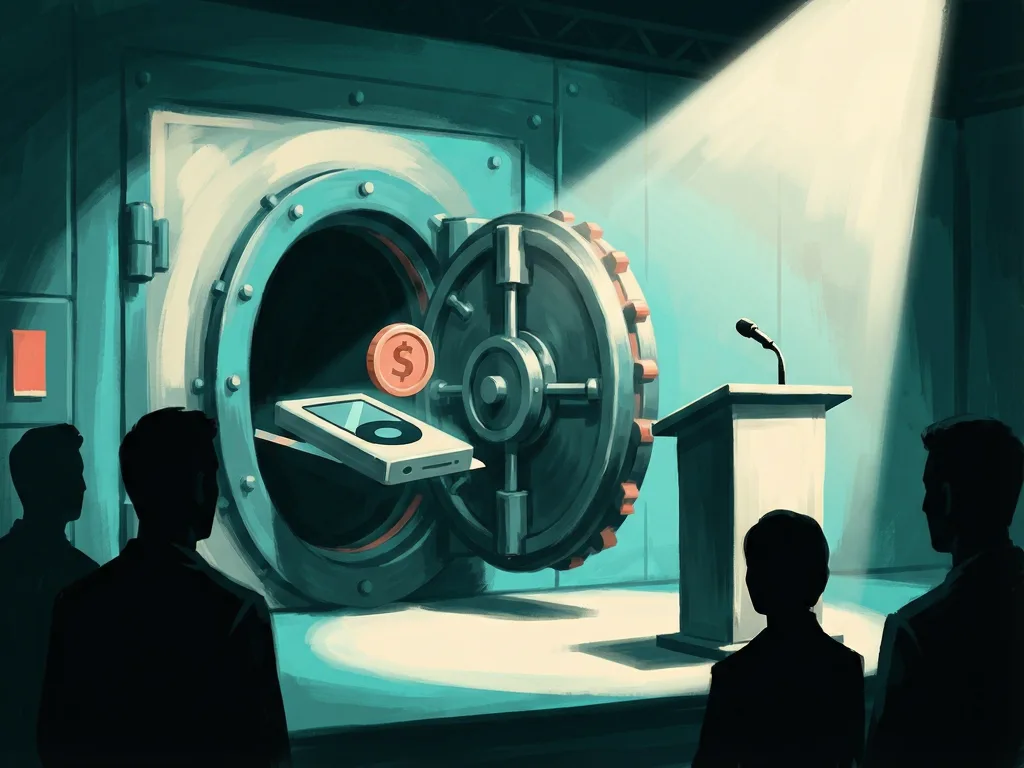
Anthony Scaramucci’s central claim is not that tokenization is a distant idea, but that it needs a narrow, visible proof point. In his view, the fastest way to make tokenized assets feel real to investors and corporate leaders is to put the 10 largest U.S. stocks on chain. If those assets can trade cleanly, compete with traditional markets, and offer round-the-clock liquidity, the competitive pressure on other companies may become impossible to ignore.
That argument comes from his conversation with Tearsheet at Stellar’s Meridian conference in Lisbon. It also rests on a longer personal history: Scaramucci began as a bitcoin skeptic, became a large investor in digital assets, and now runs SkyBridge Capital as a crypto and late-stage private equity firm managing a couple of billion dollars. He also runs the SALT conference series, which began in 2009 and has held roughly 30 events worldwide.
His current focus is tokenization. Tokenized assets are growing, and he wants stocks to be the next wave. The biggest obstacle, however, is not blockchain capability. It is regulation, competitive signaling, and investor behavior.
A skeptic’s conversion started with money, not hype
Scaramucci bought his first bitcoin at about $6,000. Before that, he had already missed the run from $500 to $2,000. He describes himself as a skeptic who changed his mind after working out what money is.
By October 2020, he had bought nine figures’ worth of bitcoin for himself and his clients. Some of those clients fired him for it. His conviction deepened after a September 2020 meeting with Michael Saylor, the MicroStrategy CEO, whom Scaramucci believes had bought his first bitcoin the month before. Scaramucci had already added more bitcoin in the $17,000 to $18,000 range, but the larger commitment followed that meeting and came in October 2020. By then, he had concluded that Bitcoin is, technically, the purest form of money.
That background matters for the tokenization argument. Scaramucci is not presenting himself as someone who always believed in digital assets. He is presenting himself as someone who moved from skepticism to conviction after rethinking money itself. His later bet on tokenized assets follows the same pattern: he wants to see whether blockchain rails can make a familiar financial product, such as a stock, behave differently.
U.S. regulation is the gatekeeper
Scaramucci identifies U.S. regulation as the biggest hurdle. Regulators abroad, in his telling, are waiting on Washington, and the Clarity Act has stalled. He expects SEC Chair Paul Atkins to issue administrative guidance that could work as well as legislation.
This is the first practical step in his sequence. Without regulatory clarity, large institutions may be unwilling to move tokenized stocks at scale. With administrative guidance, even if the Clarity Act does not pass, the industry may still get enough certainty to experiment.
After that, Scaramucci argues, the industry needs a flywheel. He names a Larry Fink, a Jamie Dimon, or a Steve Schwarzman tokenizing assets and offering 24/7 trading. The point is not merely that these are prominent figures. It is that their decisions would force competitors to respond. If one major manager or bank offers a clean tokenized version of a large U.S. stock, the question for other chief executives becomes harder to answer: why is your company not doing this?
He believes the industry has about two years to build that momentum. He also says that once momentum builds, even a regulator in the mold of former SEC Chair Gary Gensler could not put the technology back in the bottle.
That last claim is the most politically charged part of his thesis. It suggests that adoption, once visible and commercially useful, may become more powerful than regulatory resistance. But the condition is important: the momentum has to be real, not merely announced.
Tokenized stocks are the catalyst, not the deepest markets
Scaramucci acknowledges that treasuries and mortgages are the deepest markets. Still, he wants equities on chain because stocks are where investors’ attention sits.
This is a market-design judgment, not a pure technology judgment. The deepest assets may offer liquidity and institutional utility, but the most visible assets may drive adoption. If the 10 largest market-cap stocks are tokenized without glitches, other issuers and financial institutions may feel forced to follow. His logic is competitive: no CEO wants to explain why a competitor offers 24/7 liquidity and his company does not.
He also addresses a recent Wall Street Journal ad that warned investors they could lose tokenized stock. Scaramucci calls that message misinformation. In his view, fear-based warnings may confuse people about what tokenized assets are and what risks they actually carry.
The risk here is twofold. First, if early tokenized stock products fail operationally, skepticism could become entrenched. Second, if the market narrative becomes dominated by fear, investors may avoid the product category even when the underlying rails are working. Scaramucci’s argument assumes that clean execution is the best rebuttal to both problems.
The settlement case: fewer intermediaries, faster value movement
One of the strongest practical cases for tokenization is settlement. Scaramucci says a stock trade today passes through six or seven intermediaries. He started in an industry where trades settled five days after execution. Today it is one day, and settlement could drop to minutes, though regulators may not allow it.
Moving value from one wallet to another could cut out third parties that charge for credit card transactions, wires, and cashier’s checks. The same path could be applied to a house purchase. A blockchain transfer could replace the lawyers, correspondent banks, and clearing brokers that now stand between buyer and seller.
This is where the tokenization story becomes less abstract. It is not only about issuing digital versions of existing assets. It is about removing friction from the transfer of value. If settlement moves from days to minutes, the cost structure, operational risk, and customer experience of financial transactions can change.
But Scaramucci is also careful to note uncertainty: regulators may not allow minute settlement. That caveat matters because the technical possibility is not the same as the legal or supervisory permission. Faster settlement could reduce intermediaries, but it could also raise questions about investor protection, market integrity, and operational resilience.
Adoption is a behavior problem, not just a technology problem
Scaramucci frames adoption as an S curve. He resisted moving his office data to the cloud in 2006, and the cloud later proved cheaper and more secure. He offers penicillin as another example: the first person to take it was probably worried, and now everyone does.
In his telling, tokenization is at that stage. The first assets that run without glitches will settle the question. He admits he held out on contactless payments himself until last year. That personal example is useful because it shows that adoption is often delayed not by obvious danger, but by inertia, trust, and the absence of a clear need to switch.
The implication for readers is that tokenization may not win because it is technically superior in every setting. It may win because it becomes normal once early products work, once competitors copy them, and once users stop treating the technology as a novelty.
SkyBridge is running tokenized and traditional funds side by side
SkyBridge runs tokenized and non-tokenized assets side by side. Scaramucci says he bet that investors now in their late 30s and 40s are comfortable with blockchain and want to move in and out of positions quickly.
This is a demographic and operational argument. It is not just about whether tokenization is possible. It is about whether it improves the investor experience. Scaramucci says back-office and compliance work is similar for both structures and much easier with the tokenized assets.
That point gives the article a practical test. If tokenized funds require similar compliance effort but reduce friction in reporting, transfers, and access, they may be viable even before broader market adoption. If they create more complexity, the competitive logic weakens.
The strategic warning: kill your iPod
Asked what a bank head of product should focus on over the next 90 days, Scaramucci used Apple as the example. The iPod was Apple’s most successful product, and Steve Jobs folded it into the iPhone anyway.
His advice to banks is blunt: kill your own iPod before a competitor does. He tells them to “shoot first, ask questions later” and to “pretend that you’re in 2035” and get there in a hurry, because the first mover gets rewarded.
This is the core strategic message. For an established financial institution, tokenization may look like a threat to existing fee streams, clearing relationships, and product control. Scaramucci’s warning is that waiting for perfect certainty may be riskier than building the new system first.
The next 90 days, in his framing, are not a long-term research project. They are a window to act before a competitor forces the issue.
Wolfgang Puck and the rebuild cycle
Scaramucci also points to Wolfgang Puck as a model for rebuilding a business that is already working. Puck closed Spago after a decade, rebuilt it, and kept repeating the cycle for 50 years, and the restaurant is still hot.
Scaramucci wants to break down and rebuild his own business the same way, starting with technology for his conference business. He also plans to grow SkyBridge’s late-stage secondary business, which has held Anthropic, SpaceX, and OpenAI.
On the tokenization side, he is betting that Stellar will be one of the big backbones.
The analogy is important because it reframes tokenization as an operational rebuild, not a single product launch. Puck’s method was not merely to keep Spago going. It was to close, redesign, and reopen. For financial firms, Scaramucci’s message is similar: do not just bolt tokenization onto legacy processes. Rebuild the process.
What the thesis depends on
Scaramucci’s case is strongest when it is read as a sequence, not a prediction. The sequence is: SEC guidance, a major issuer tokenizing large U.S. stocks, clean execution, 24/7 trading, competitive copying, and then broader adoption.
The uncertainty is embedded in each step. The Clarity Act has stalled. Administrative guidance may work, but it is not legislation. The first movers may not be Fink, Dimon, or Schwarzman. Tokenized stocks may face operational glitches. Regulators may not allow minute settlement. Investor messaging may become distorted by warnings about tokenized stock losses.
Still, the argument gives readers a concrete way to watch the category. The question is not whether tokenization is inevitable. The question is whether a small set of visible, well-executed products can turn tokenized assets from a technical possibility into a competitive necessity.
Source note
The views described here come from Anthony Scaramucci’s conversation with Tearsheet at Stellar’s Meridian conference in Lisbon. The original article appeared first on Tearsheet.
This is an independent informational article, not an official notice. It is not investment advice. Tokenized and crypto-related products may involve fees and regional restrictions.
SubjectsTokenizationblockchainAnthony ScaramucciStellar MeridianUS Stocks
Read next


Letters 0
- No letters yet. Be the first to write in.