
States and cities are turning to cryptocurrency kiosk bans as scam losses increase.
Cryptocurrency kiosks face growing bans as cash-to-crypto fraud losses climb, especially among older adults, shifting from safeguards to removal.
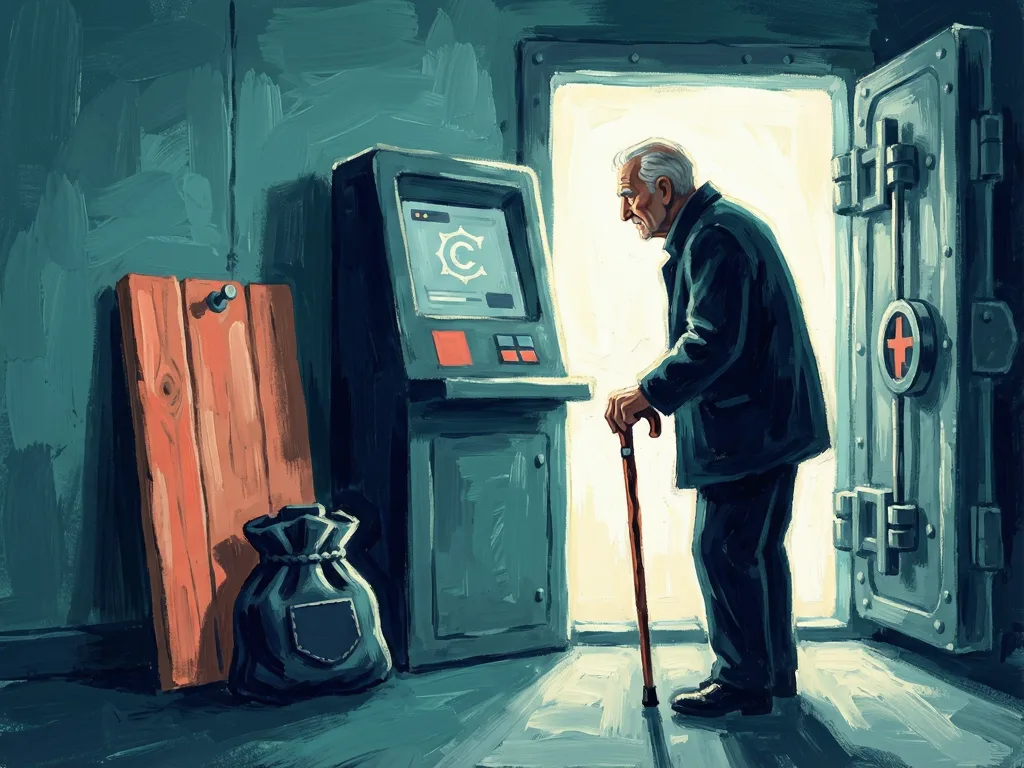
This is an independent informational analysis, not an official regulatory notice and not investment advice. Crypto kiosk availability is subject to state and local restrictions, and transaction fees can be high.
Core judgment: regulators are moving from control to removal
The central shift in the crypto kiosk debate is no longer about how to make the machines safer. It is about whether they should remain legal at all.
Indiana, Minnesota, Tennessee and Vermont enacted statewide bans this year, according to a Stateline report published Monday, Nov. 16. Hawaii took a narrower approach, prohibiting consumers from depositing cash into kiosks to purchase cryptocurrency under a law effective in October.
That change matters because kiosk regulation was once framed as a consumer-protection problem: require warnings, limit transactions, verify identity, or license operators. The new bans suggest that many policymakers now view cash-to-crypto kiosks as structurally dangerous, especially when they are repeatedly tied to fraud and cash conversion.
At least 35 states have enacted kiosk legislation since 2023, including 18 this year, according to AARP. The spread of laws shows a broad regulatory response. But the character of that response has changed. Bans are no longer isolated experiments. They are becoming a recognizable policy option.
Data and enforcement: why the pressure grew
The policy turn is grounded in fraud data.
The FBI received 13,460 kiosk-related complaints in 2025, with reported losses approaching $389 million. Complaints rose 23% from the previous year, while losses increased 58%.
Those numbers point to a key problem: kiosk fraud is not only becoming more common, it is also becoming more costly per complaint. A 23% increase in complaints paired with a 58% increase in losses suggests that some incidents are producing larger individual damages, or that fraud is increasingly concentrated in high-loss schemes.
The age profile adds another layer. People older than 50 accounted for more than half the complaints and over $302 million in losses, per the report. That makes kiosk fraud a significant elder-fraud issue, not merely a cryptocurrency adoption issue.
The reason is straightforward. Crypto kiosks convert physical cash into digital currency. Unlike conventional ATMs, crypto kiosks do not simply dispense or accept banknotes in the usual ATM sense. They move value into a digital asset that can be transferred quickly and, in many cases, cannot be reversed.
Scammers exploit that structure. They persuade victims to withdraw bank deposits and feed the cash into machines, often using a QR code directing the cryptocurrency to a criminal wallet. They may remain on the telephone throughout, coaching victims through each step.
This turns the kiosk into a payment endpoint. It is not the fraud itself, but it becomes the place where stolen money leaves the victim’s reach.
Local bans: the problem moved from statehouses to town halls
Statewide bans are only part of the picture. Local governments are following.
At least 20 Massachusetts communities had banned kiosks as of August. Jackson, Michigan, implemented a ban in late October, giving operators until the end of January to remove machines. Star, Idaho, passed a September ban requiring removal by November.
The local dimension shows why kiosk policy has become politically difficult for operators. These machines are physical. They sit in stores, convenience venues or other public-facing locations. That gives residents and municipal officials a concrete target.
Unlike online platforms, kiosks can be seen, removed, restricted or banned by local ordinance. The machines make abstract crypto risk visible in the everyday economy. A town can ban a device in a storefront more easily than it can regulate a global digital asset market.
This also explains the shift from regulation to prohibition. Regulators can impose rules on how kiosks operate. But local officials may prefer removal when the machines are associated with scam payments, harassment, distress or repeated victim reports.
How the fraud works: cash, QR codes and social pressure
The fraud model is simple but effective.
Impersonation schemes involve criminals posing as police, government officials, bank employees or technical support representatives. Victims are told they owe money, face arrest or must move savings to protect them from fraud. Other schemes use online romances or fraudulent investment opportunities to induce payments.
The common thread is pressure. Victims are not simply buying cryptocurrency. They are being manipulated into converting money into a form that can be sent away quickly.
The use of QR codes is especially important. A QR code can direct a kiosk transaction to a specific wallet address without requiring the victim to understand digital wallet mechanics. For a frightened or confused person, the machine can become a one-way payment tool.
The risks extend to younger victims. Connecticut State Police Detective Matt Hogan described kiosk use in financially motivated sextortion, where perpetrators threaten to distribute intimate images unless victims pay. The FBI has warned that such schemes increasingly target boys ages 14 to 17. Investigators also link kiosks to money laundering, drug offenses and payments involving child sexual abuse material.
That broader criminal connection changes the policy question. It is not only whether elderly consumers can be protected from telephone scams. It is also whether the machines provide a cash entry point into criminal payment networks that are harder to monitor than bank transfers.
Why recovery fails: irreversibility, fees and operator incentives
The kiosk problem is made worse by what happens after payment.
Recovery is difficult because cryptocurrency transfers generally cannot be reversed. Operators also typically charge transaction fees of 20% to 30%, regardless of whether a transaction involves fraud, the report said.
This fee range is a major consumer-protection issue. If a victim sends $1,000 through a kiosk, a 20% to 30% fee can leave only $700 to $800 converted into the intended digital asset, before considering exchange-rate movement or wallet-routing losses. If the transaction is fraudulent, the fee does not protect the victim. It is charged anyway.
The irreversibility of transfers also limits traditional remedies. In bank fraud, payment networks can sometimes reverse or freeze transfers. In card fraud, chargebacks exist. With crypto, once the transaction is broadcast to the network, recovery depends on identifying and compelling the recipient, or tracing the funds to a point where authorities can act.
That is why enforcement actions have added pressure.
Attorneys general in Washington, D.C., Iowa and Massachusetts have sued operators over alleged exploitation and inadequate safeguards. Iowa’s attorney general reported that a three-year investigation linked 98% of Bitcoin Depot transactions and 94% of CoinFlip transactions in the state to scams, prompting lawsuits against both companies. Bitcoin Depot declared bankruptcy in May.
Those figures are unusually stark. If a state investigation links nearly all transactions from a named operator to scams, the legal and reputational risk becomes existential. Bankruptcy then becomes not only a financial event, but a policy signal: the business model may not survive the combination of lawsuits, regulation and fraud exposure.
Operator response: safeguards, reversals and a defense of legitimate use
Crypto kiosk operators argue that stronger safeguards and enforcement can preserve legitimate services. Some, including CoinFlip, have introduced holding periods allowing reversals, refunds for scam victims and round-the-clock support. Other jurisdictions require fraud warnings, identification checks or transaction limits.
The operators’ position is that kiosks are not inherently criminal infrastructure. They can serve users who want to purchase cryptocurrency with cash, especially where bank access, digital literacy or online payment options are limited. From that perspective, the problem is not the machine itself, but how criminals manipulate people into using it.
That argument has some logical force. A phone can be used for fraud, but society does not ban phones. Cash can be used for scams, but cash is not prohibited. The question is whether kiosks create a uniquely efficient bridge from physical cash to irreversible digital value.
The operator countermeasures attempt to answer that concern. Holding periods give time for intervention. Refunds restore some of the consumer protections that blockchain irreversibility removes. 24-hour support may help victims report fraud before funds move further. Fraud warnings, identification checks and transaction limits can reduce exposure.
But these fixes also reveal the weakness of the model. If the core issue is that a vulnerable person can walk into a store, insert cash and send value to a stranger within minutes, then safeguards may reduce risk without eliminating it.
CoinFlip criticized eliminating an industry serving legitimate customers. Supporters of tougher restrictions emphasize the cost of delay. As AARP government affairs director Françoise Cleveland told Stateline, “Every day that these laws aren’t passed are days where victims are having money stolen from them.”
That sentence captures the regulatory urgency. For operators, a ban is a business loss. For victims, delay is money stolen.
The policy tension: bans versus visibility
Detective Hogan’s concern adds a second-order risk.
Hogan supports consumer protections but worries bans could drive criminals toward payment channels investigators have less visibility into. Public blockchain records can help authorities trace funds, even when identifying recipients and recovering money remains difficult.
This is the core trade-off.
Kiosks are visible. They have locations, operators, transaction logs and public blockchain addresses. Investigators can trace where cash becomes crypto. They can sometimes follow funds across public ledgers.
If kiosks disappear, criminals may shift to other payment methods. Some may be harder for law enforcement to trace. Cash-by-mail schemes, peer-to-peer transfers, gift-card fraud, informal crypto markets or other channels could fill the gap.
The uncertainty is whether removing kiosks reduces total fraud or merely changes its route. The data so far shows why states and towns are willing to accept that uncertainty. The current kiosk environment is producing large reported losses, repeated complaints and severe impacts on older victims.
From a policy standpoint, the question is not only whether kiosks are traceable. It is whether their traceability is enough to justify their presence. If traceability rarely leads to recovery, and fees remain high, and victims continue to suffer, regulators may decide that visibility is not worth the cost.
Indiana as the test case
Indiana illustrates the competing approaches. Lawmakers initially considered licensing, identity verification, transaction and fee limits before choosing a ban after testimony from victims, investigators and industry representatives.
That sequence is revealing. The state did not jump immediately to prohibition. It first considered rules that might preserve the service while reducing harm. The decision to move to a ban suggests that those rules were seen as insufficient.
Licensing can control who operates kiosks. Identity verification can make transactions less anonymous. Fee limits can reduce predatory pricing. Transaction caps can limit loss per incident. But none of those measures necessarily prevents a coerced victim from withdrawing cash and using a kiosk under telephone direction.
The Indiana example shows the limits of incremental regulation. If the machine can be used in a scam despite compliance checks, then the physical payment point itself may be considered the problem.
What readers should take from the kiosk fight
The crypto kiosk debate is not simply about cryptocurrency. It is about payment rails, consumer vulnerability and the point where cash becomes irreversible digital value.
For older consumers, the risk is acute. People older than 50 accounted for more than half of complaints and over $302 million in losses. For younger users, the risk includes sextortion and abuse-material payments. For investigators, kiosks are useful because they are visible, but that visibility has not solved recovery. For operators, kiosks serve customers, but lawsuits, scam-linked transaction data and bankruptcy show how fragile that business can become.
The practical warning is blunt: a crypto kiosk should not be treated like an ordinary ATM. It converts cash into digital value, often with high fees, and the resulting transfer may be difficult or impossible to reverse.
The policy warning is equally clear: regulators are no longer only asking how to control kiosks. They are increasingly asking whether the public cost of allowing them exceeds the benefit of keeping them legal.
Subjectsscam preventioncryptocurrency kiosksstate regulationelder fraudcrypto law
Read next

Letters 0
- No letters yet. Be the first to write in.