
Payment processors are competing to offer checkout with passkeys.
Adyen and Checkout.com add Visa passkeys to UK checkout, cutting verification friction for saved-card repeat purchases while keeping fallback methods.
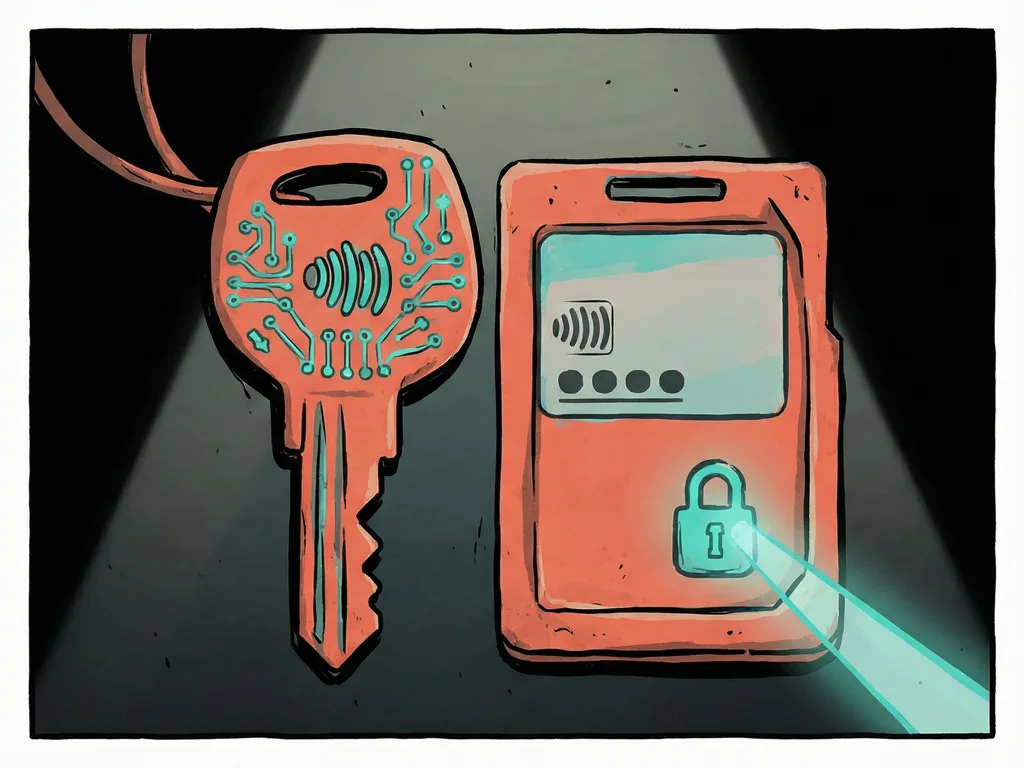
Adyen and Checkout.com Bring Visa Payment Passkey to U.K. Checkout, Where 80 Percent of Shoppers Already Save Card Details
Payment processors are placing passkeys inside the verification step that happens before a payment is sent to a card issuer for approval. The central judgment is simple: the passkey is not a new card network or a new checkout button. It is a replacement for one of the most disruptive interruptions in online payment—the verification prompt—especially for shoppers who already saved their card details and expect the next purchase to feel almost automatic.
The timing matters because stored credentials have already solved one friction point. The PYMNTS Intelligence "Checkout Paradox Tracker" with PayPal found that 80% of shoppers use stored payment credentials. Saving the card removes the need to type it in. The passkey addresses the next interruption, when the shopper is asked to verify the purchase. Separate PYMNTS Intelligence research with Worldpay showed that 84% of shoppers considered one-click checkout important when deciding where to shop, and 18% chose their preferred shopping channel solely on whether it was available. That makes verification a competitive feature, not just a security checkbox.
How the passkey fits into authorization
The mechanics are narrow but important. The processor's authentication software supports passkeys. The retailer sends the processor a payment request when the shopper taps a card. The processor checks which verification methods are available for that transaction. If it selects a passkey, the shopper's device asks for a fingerprint, face scan or PIN and uses a cryptographic key to prove the shopper has access to the registered device. The private key stays on the device. Once verification is complete, the processor continues with the payment request, and the issuer decides whether to approve the charge.
Two recently announced rollouts put that model into the market. Adyen is introducing Visa Payment Passkey through Authenticate, starting in the U.K. Checkout.com is offering it through its existing authentication integration, initially to selected merchants in the U.K. and Europe. Checkout.com said eligible merchants can add it without building a separate checkout flow and that existing verification methods remain available when a passkey cannot be used.
The practical effect is that the passkey sits between the retailer's payment request and the issuer's approval decision. It does not replace the issuer. It changes how the shopper proves they are the legitimate user of the device and card before the issuer is asked to approve the charge.
Repeat purchases are the clearest opportunity
For retailers, the most useful question is not whether a passkey exists in the checkout stack, but where it reduces interruption. The opportunity is clearest on repeat purchases. A shopper who saved a card is already signaling intent to return. A verification prompt is the moment that intent can be lost.
Adyen's documented pilot shows a path that merchants can evaluate. The shopper first completes a standard issuer challenge and then gets the option to create a passkey. When the shopper returns with the same card and device, Adyen's Authentication Engine determines whether the purchase requires a challenge and which method to use. It considers factors including the browser and payment method. If it selects the passkey, the device prompt takes the place of another issuer challenge. If the passkey is ineligible or the engine selects another method, the shopper may still see a bank prompt.
The documented flow also distinguishes a shopper placing a repeat order from a merchant charging a subscription automatically. The latter is outside the scope of the passkey flow. That distinction is important for merchants who expect one feature to smooth every return visit. A repeat order and an automatic subscription charge are different payment events, and the passkey rollout described here does not cover both.
What merchants should compare
A retailer comparing processors should look at three numbers. The first is how often shoppers have to respond to a verification prompt at all. The second is how often those shoppers are offered a passkey. The third is how often they complete the purchase after seeing it, compared with shoppers who get the bank's usual prompt. A passkey can simplify a purchase that would otherwise require a bank challenge, but only if it is offered when relevant and completed without adding another dead end.
These metrics turn the rollout from a feature announcement into a measurable checkout test. If the passkey is rarely offered, merchants will see little difference. If it is offered but ineligible in common browser or device combinations, the shopper may still see a bank prompt. If it is offered and completed at a higher rate than the usual prompt, it becomes a conversion tool as well as a verification method.
Cross-border routing makes the handoff harder to ignore
The passkey issue is not only about one checkout screen. PYMNTS Intelligence and Worldpay found that 55% of firms with a strong cross-border focus use automatic payment retries. For merchants that route payments through multiple providers, that makes the connection between verification and authorization critical.
The handoff affects what the shopper experiences during an outage. If the backup route can carry the verification result, the shopper can proceed to authorization on that route. If the backup route requires fresh verification, the shopper may face another prompt. For a retailer comparing processors, that puts the checkout experience on the backup route alongside the experience on the primary one.
This is where the competitive question becomes operational. A passkey that works on the main route may not be enough if a retry moves the payment to another provider or another authentication path. Merchants need to know whether verification travels with the transaction or resets when routing changes. The described passkey flow addresses verification before issuer approval, but the outage example shows that the real checkout experience may depend on whether the backup route preserves the result.
Limits, uncertainty, and what remains unknown
The rollout is still geographically and operationally limited. Adyen's Visa Payment Passkey through Authenticate starts in the U.K., while Checkout.com's offer is initially to selected merchants in the U.K. and Europe. Checkout.com says existing verification methods remain available when a passkey cannot be used, which suggests the passkey is one option among several, not a replacement for all authentication.
The material does not specify merchant fees, so pricing remains an open question for readers evaluating cost. It also does not give passkey adoption rates, completion rates, or issuer approval outcomes beyond the general flow. Those gaps matter because a processor feature is only valuable if it appears at the right moment, on the right device, with the right card and browser context.
For shoppers, the likely near-term experience is mixed. Some repeat purchases may become simpler, with a device prompt replacing a bank challenge. Others may still see the usual prompt when the passkey is ineligible, when the engine selects another method, or when a backup route requires fresh verification. For merchants, the takeaway is to treat passkey support as a checkout metric: measure prompt frequency, offer rate, and completion rate rather than assuming the feature will automatically reduce friction.
This is an independent informational analysis, not investment advice.
SubjectsVisaPayment PasskeysCheckout AuthenticationAdyenCheckout.com
Read next


Letters 0
- No letters yet. Be the first to write in.