
How does the use of credit cards by AI agents affect cryptocurrency?
AI agents may use crypto for machine payments, but cards may retain consumer commerce via merchants, protections, tokenization, and controls.
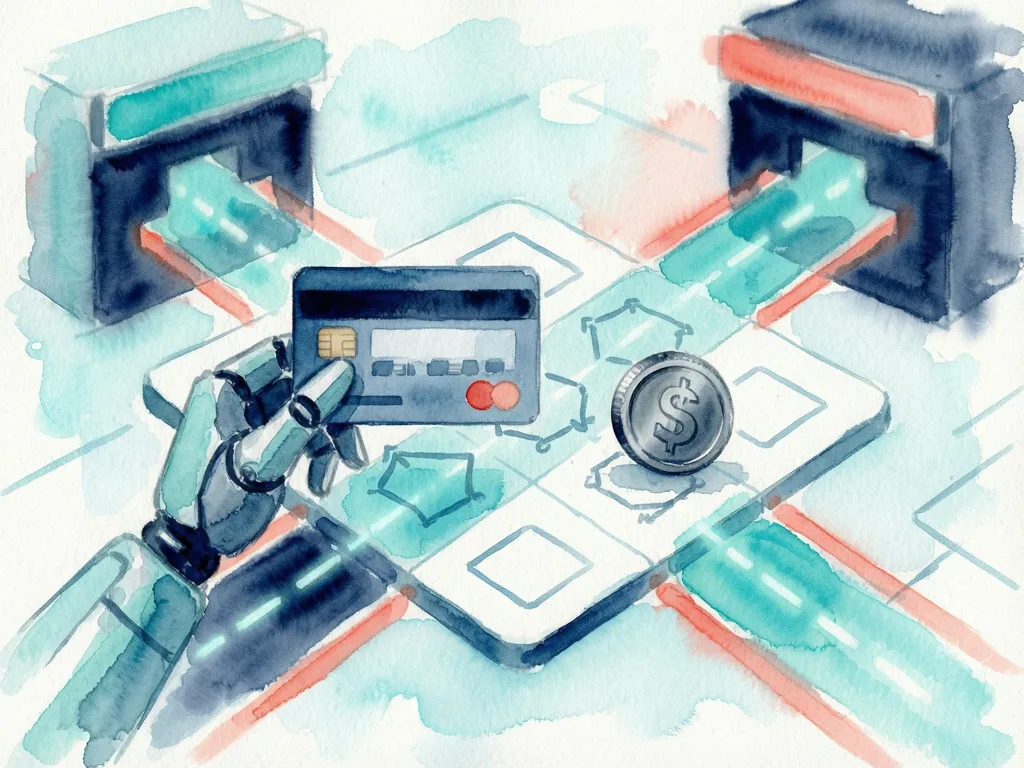
The most useful way to read the debate over AI-agent payments is not as a simple race between crypto and credit cards. The stronger core judgment is this: autonomous agents may need blockchain-based rails when machines pay machines for tiny, frequent transactions, but card networks and large financial institutions are still positioned to own the customer relationship. Crypto may become the plumbing under agentic commerce without automatically becoming the face of it.
That conclusion matters because the original industry thesis is widespread. The idea that crypto will become the default payment choice for autonomous AI agents is common in the industry. The reasoning is straightforward: AI agents cannot open bank accounts and need to make lots of transactions, so they will inexorably gravitate toward instant, decentralized and low cost crypto payments. But the credit card industry has no intention of letting that happen without a fight.
The card networks are already moving into the agent economy
The Wall Street Journal reported on Nov. 19 that AI agents are already using credit cards to make purchases on consumers’ behalf, and banks and payment companies are racing to accommodate them. This is not a distant theoretical scenario. It is the first practical version of agentic commerce: an agent acts on a person’s instruction, pays a merchant that already accepts cards, and stays inside familiar consumer-payment structures.
Jonah Van Bourg, a crypto trader and co-host of the 1000x podcast, posted a screenshot and commented: “Agents will not use crypto rails. The book is closed on blockchain as a solution, outside of niche back office applications. Its only use cases are sov, privacy, and ledger stuff. Sad.”
That is a strong dismissal. But experts argue the jury is still out. David Krause, professor emeritus of finance at Marquette University, tells Magazine that credit cards offer some advantages, but high costs could be their downfall in certain scenarios.
His point is specific: “Credit cards were built for a world where a human decides to pay, so when an agent pays $0.005 for an API call, the fixed fees on card rails are 50x the transaction itself.”
Stablecoins, he says, make much more sense for “those situations involving micropayments.”
When an agent is really a human’s delegate, cards remain powerful
The payment rail depends on what the agent is buying. Credit card payments are the default for most human-initiated transactions on the web. So an agent tasked with booking a flight or a hotel room may also default to this type of payment.
Lewis Nurcombe, chief revenue officer at WalletConnect, tells Magazine: “When an agent books your flight or reorders your groceries, it’s acting for a person, at a merchant that already accepts cards, with consumer protections people expect, like chargebacks.”
Visa’s recent paper on the rise of agentic commerce adds another layer. It says tokenization can give agents permission to transact without needing to expose the cardholder’s underlying payment details, and spending controls can restrict the purchases they can make.
This is why the card-rail argument is not weak. If the merchant already accepts cards, and if the merchant and payment network already have familiar mechanisms for handling disputed transactions, it is hard to argue the virtues of introducing an entirely new payment system. The agent is not acting in a completely new economic space; it is acting inside an existing retail and web-commerce space.
The related reporting cited in the source shows why this pressure is real. One report says DeepSeek is developing an AI agent requiring less human input. Another related report says banks are banning AI agents over security and competition concerns. The practical question is not only whether agents can pay. It is whether existing financial institutions will let agents operate inside their systems, restrict them, or absorb them.
Machine-to-machine payments change the economics
The economics start to change when agents begin paying other machines.
AI agents may create a new economy of machine-to-machine transactions, where agents buy access to a dataset, request computing power, or pay to access a single piece of information. Many of these transactions may only be worth a fraction of a cent and potentially need to occur thousands of times without a human approving each one.
Aitor Argomaniz, chief executive of AI payments company Nevermined, tells Magazine: “If an agent wants to pay a few cents for one API call or one piece of data, card fees don’t make sense.”
That is because card networks were designed around transactions big enough to absorb fixed processing fees, rather than micropayments. A $0.005 API call is not merely a small payment. It is a payment that can make the fixed cost structure of traditional card rails economically absurd.
Stablecoins offer a different model. Agents can hold funds in a wallet, make payments programmatically and settle transactions onchain without going through a conventional checkout process.
Nurcombe says that stablecoins are most useful “wherever the transaction is too small, too frequent or too global for cards to make sense.”
x402 is presented as an open, neutral standard for internet-native payments. Nevermined compared 100 API calls priced at 10 cents each. Using a conventional card via Stripe would not be an option as the payments infrastructure network rejects charges under $0.50. But using stablecoins, the company estimates the same 100 payments would cost around 10 cents in total using Coinbase’s x402 facilitator on Base.
That comparison is the strongest case for crypto rails in the agentic economy. It shows a concrete category of transaction where card processing is not merely slower or more expensive, but structurally impractical.
Stablecoins are not automatically the winner
The same source also blocks a simplistic crypto-triumphalist reading. A number of microtransactions could be aggregated into a single card payment. That changes the unit economics. If an agent makes thousands of tiny calls but only needs to settle once per day, per user, per service, or per application, a card network may become viable again.
Stablecoin transactions also carry costs related to infrastructure, conversion, custody and liquidity. The Bank for International Settlements, or BIS, found that stablecoin transfers can still incur trading, conversion and withdrawal fees, while limited liquidity between stablecoins and local currencies can add further friction.
This is important for readers evaluating the claim that crypto payments will be cheap and automatic. Cheapness depends on the full path, not just the token transfer. A stablecoin payment may look efficient at the settlement layer while still requiring conversion into a spendable currency, custody arrangements, wallet infrastructure, and liquidity for merchants or users. Those frictions can matter a lot when transactions are repeated at high frequency.
So the stablecoin case is strongest in a narrow but potentially large domain: machine-to-machine micropayments, programmatic settlement, and transactions too small, too frequent or too global for cards. It is weakest when merchants already accept cards, when disputes require consumer protection, and when the transaction can be batched.
Liability attribution may matter more than the rail itself
In the transition to agentic finance, there is a more fundamental question to overcome: who is responsible when an agent gets something wrong?
Krause says: “I tell my students the real question isn’t ‘crypto or cards,’ it’s who solves the agent identity and liability attribution issues.”
“That’s because the first time an agent books the wrong flight, someone has to own that dispute, and that’s a 50-year competency the crypto world hasn’t built yet.”
This is where the debate becomes more complicated than fee comparison. A payment rail is not only a settlement mechanism. It is also a dispute-resolution system, a trust system, and a liability system. Chargebacks, customer support, merchant verification, identity controls, and regulatory relationships are not decorative features. They are the reason traditional finance remains sticky.
One partial solution is a separate wallet funded with a limited amount of money that could prevent an agent from accidentally draining a user’s main account.
WalletConnect is developing ways for users to give agents access to dedicated wallets while retaining control over the rest of their funds.
“The most an agent can ever spend is what the person chose to give it,” Nurcombe says.
But spending limits only mitigate the damage. They cannot determine who is liable when an agent makes an unauthorized purchase, buys the wrong service or falls victim to manipulation. Nor do they provide the kind of resolution consumers expect from established payment providers.
That may mean banks and card networks have an advantage beyond just having more merchants on their systems. They already have relationships with customers, businesses and regulators, as well as established processes for handling disputes.
Krause says that stacks the odds in traditional finance’s favor. “My bet is the large TradFi players will ultimately win,” he says. “They’re the ones with funding access and are positioned to straddle the divide and offer a hybrid version.”
The likely outcome is hybrid rails, not total crypto capture
This is where Van Bourg’s argument becomes harder for the crypto industry to dismiss. Even if stablecoins are useful for machine-to-machine payments, established payment networks could just incorporate them without handing over control of the customer relationship.
So an agent might interact with Visa or Mastercard while the networks use blockchain infrastructure behind the scenes.
That would effectively turn blockchain into payment plumbing without businesses or consumers needing to hold crypto or interact with a decentralized protocol.
Mastercard completed its acquisition of stablecoin infrastructure provider BVNK in August, in a deal announced at up to $1.8 billion, giving Mastercard the infrastructure to connect fiat and onchain payments.
The $1.8 billion BVNK deal is not just a corporate transaction. It is evidence that large card networks are not waiting for crypto to replace them. They are buying capabilities. If agents need to settle tiny machine-to-machine payments, the networks can absorb stablecoin infrastructure while keeping the merchant relationships, dispute processes, tokenization controls and regulatory interfaces they already own.
Nevermined supports payments using both cards and stablecoins, and Argomaniz expects the two systems to coexist, “at least for the next few years.”
That coexistence is probably the most realistic near-term scenario. Crypto rails may power specific agent transactions where cards fail economically. Card rails may continue to dominate transactions where cards already work socially, legally and commercially. The deeper question is whether crypto remains a visible payment choice or becomes invisible infrastructure underneath traditional finance.
What readers should watch next
For readers, the practical takeaway is not to assume that AI agents will automatically choose crypto. The likely path is more selective and more institutional.
Watch three things first.
First, watch the unit economics. The $0.005 API-call example matters because it exposes a structural weakness in card rails for micropayments. If agentic transactions are mostly human-facing purchases, cards remain strong. If they become machine-to-machine, stablecoin rails gain a real advantage.
Second, watch liability design. The “crypto or cards” framing can be misleading if the harder problem is agent identity and responsibility. A wrong flight booking is not only a payment event; it is a consumer dispute. Spending limits and dedicated wallets help, but they do not create a mature dispute-resolution culture overnight.
Third, watch infrastructure absorption. Mastercard’s completed acquisition of BVNK in August, in a deal announced at up to $1.8 billion, shows that traditional payment networks are willing to buy onchain capabilities rather than ignore them. The result could be a system where agents use stablecoin settlement without consumers or merchants ever directly holding crypto.
The source also raises a broader related question from Magazine: How to preserve wealth and access funds during a national emergency. That question is relevant here because agentic finance will force users to think about control, access, fallback options and liability when autonomous systems move money without constant human review.
This is an independent informational analysis, not an official statement and not investment advice. Payment methods can involve fees, and availability may be subject to regional restrictions. The outcome remains uncertain because it depends on how quickly agents are deployed, how merchants adopt new rails, whether card networks successfully absorb blockchain infrastructure, and whether crypto-native systems can build the liability and dispute-resolution functions that traditional finance already has.
SubjectscryptocurrencyPaymentsAI Agentscredit cardsblockchain
Read next


Letters 0
- No letters yet. Be the first to write in.