
Business-to-Business invoices have evolved into payment infrastructure.
Invoices are becoming executable payment infrastructure, enabling real-time finance decisions through AI and trusted data.
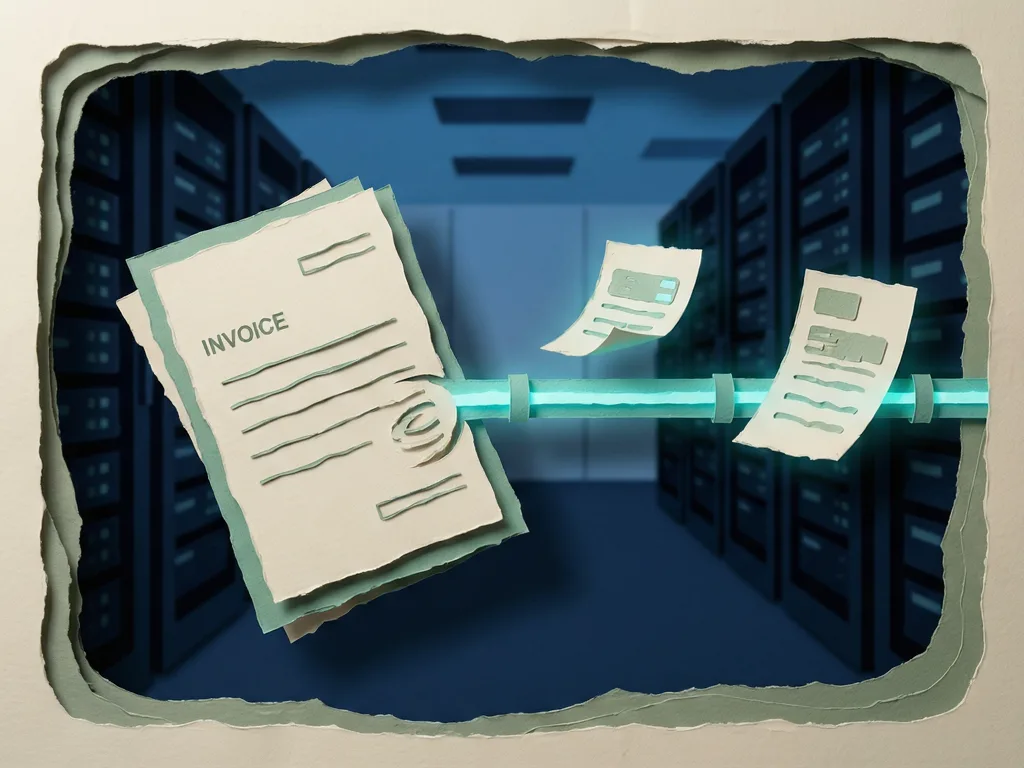
The core shift is that invoices are no longer only records of what a company owes. As embedded finance, automated procurement and agentic payments converge, the invoice is becoming infrastructure that can influence when, how and through whom money moves. A document that once launched back-office tasks can now shape capital deployment.
For finance leaders, that creates a new category of risk and opportunity. The same commercial transaction can be read as a payable, a liquidity signal, a financing decision and a data point about spending behavior. The question is no longer only whether invoice data can be captured. It is whether invoice data can be trusted enough to drive payment decisions.
The $500,000 Example Shows Why the Invoice Is No Longer a Terminal Record
A $500,000 equipment purchase illustrates the change. In a traditional finance workflow, the invoice would arrive, be checked against internal records and enter accounts payable as a payable due in 60 days. Its function was largely documentary.
Today, the same transaction can carry several meanings at once. It can represent a future liquidity requirement, an opportunity for supplier financing, a potential early-payment discount and a signal about capital expenditure trends. The value is not only the amount owed. It is also the timing, the context and the options the transaction makes visible.
This is where invoice-level intelligence becomes more useful than invoice-level processing. Making the information available sooner gives finance teams a chance to influence outcomes rather than simply report them.
From Human Interpretation to Structured Action
The deeper change is not just faster invoicing. It is a move from documents that humans interpret to structured information that software can act upon.
Two years ago, an invoice was mostly something a supplier sent to a buyer to process an obligation. Payment terms, transaction amounts, counterparties and due dates traveled through accounting systems, often becoming useful to treasury only after validation and reconciliation. The invoice documented an economic commitment, but it rarely influenced that commitment.
Electronic invoicing, APIs and integrated enterprise resource planning platforms now make transaction-level information available earlier and in more structured formats. AI systems can help classify obligations, identify discrepancies, predict payment behavior and connect individual transactions to broader patterns in corporate cash flow.
The invoice is becoming a set of executable facts.
The Automation Signal: 70% of Firms Within 12 Months
The August PYMNTS Intelligence report “Payment Protection: Why Firms Still Aren’t Real-Time Ready” found that 70% of surveyed firms plan within 12 months to adopt or expand automation that matches and clears payments against invoices, ledgers and bank statements.
That statistic matters because matching and clearing payments is the technical foundation for real-time finance. If a system cannot reliably connect a payment to an invoice, a ledger entry and a bank statement, it cannot safely move from reporting to action.
Ryan Taylor, Senior Vice President of Product Management for Mobility and Payments at WEX, framed the issue in broader terms. “Payment data is interesting because it really is the digital footprint of a business,” he told PYMNTS. “It tells you more than just what was spent. It can tell you about what was happening in the business at that exact moment that a payment occurred.”
His warning is more important than the quote’s polish. “The organizations that get the most out of AI won’t be the ones that add chatbots to legacy systems,” he added. “They’re the ones who are going to treat payments as a core infrastructure.”
What an Agentic Invoice Could Do
If payments are treated as core infrastructure, an AI agent can move beyond reading an invoice. It could receive the invoice, compare it against a purchase order and delivery confirmation, investigate discrepancies, evaluate available payment terms and recommend the optimal settlement date based on projected liquidity.
That is a narrow use case, but it changes the role of the invoice. The document becomes input for the next decision.
The practical implication is that finance teams may no longer be limited to reporting what has already happened. They can intervene earlier: whether to pay early, whether to use supplier financing, whether to hold cash, or whether to escalate a mismatch before it becomes a payment failure.
Enterprise Software Is Moving Toward Payment Execution
The changing role of the invoice is also reshaping competition among enterprise technology providers and financial institutions. A milestone cited in the source is SAP’s October 2026 introduction of SAP Pay. By embedding payment capabilities into its cloud enterprise resource planning environment, SAP is positioning enterprise software to play a more direct role in payment execution.
The described scope includes the potential orchestration of conventional payment rails and stablecoin settlement. That does not mean every invoice will be settled autonomously. It means the boundary between a system of record and a system of payment is narrowing.
Banks, enterprise software providers and payments platforms are competing around the same object: the structured commercial transaction. The advantage may go to the provider that can turn invoice data into a safe, auditable payment path rather than simply storing the data better.
Revenue Leakage Raises the Stakes
The urgency is not only about operational efficiency. Data in “The Payment Guarantee Gap: Why Adoption Lags Despite Perceived Value,” a PYMNTS Intelligence report produced in collaboration with Plaid, revealed that more than two-thirds of surveyed firms lose or delay revenue when payments fail.
That finding reframes invoice automation as part of revenue protection. If failed payments directly affect revenue, then invoice data becomes a control point, not just a back-office artifact.
Historically, receivables and payables were managed through separate optimization exercises. Collections teams attempted to accelerate incoming cash, while accounts payable departments sought to preserve liquidity by managing outgoing payments. That separation made sense when invoice data was slow and hard to connect. It becomes less useful when the same transaction record can support both sides of the cash cycle.
Invoice intelligence creates the possibility of coordinating those decisions. Rather than applying standardized payment policies across the supplier base, connected financial systems could evaluate individual invoices against cash forecasts, supplier financing needs, discount opportunities and available credit facilities.
A $500,000 equipment invoice, for example, could trigger a comparison between early-payment discount value, financing cost and forecast cash availability. That is not merely accounting automation. It is capital allocation at transaction level.
The Limits, Risks and Open Questions
The business-to-business invoice is not disappearing, and its basic legal and accounting function is not fundamentally changing. Companies will still need to establish what was delivered, what is owed and when payment is due.
What is changing is the economic value of that information. That distinction matters because infrastructure can create leverage, but it can also amplify errors.
Several risks remain.
First, data quality. If invoice, purchase order and delivery data are incomplete or mismatched, automated matching may clear the wrong obligation. Faster processing without clean data can simply produce faster exceptions.
Second, control design. If an AI agent recommends or executes settlement, the organization needs clear rules for human review, exception handling and audit trails. The question is not only whether the system can act, but whether it can be stopped, corrected and explained.
Third, model error. Predicting payment behavior, liquidity impact or optimal settlement dates is only as reliable as the historical data and assumptions behind it. A model that recommends early payment based on incomplete cash forecasts could strain liquidity in a different part of the business.
Fourth, adoption lag. The report title itself says firms still are not real-time ready, and the payment guarantee gap report notes adoption lags despite perceived value. The gap between planned automation and operating readiness is where the real risk sits.
The source material does not specify fees or regional restrictions for SAP Pay or other payment services, so those constraints remain outside the evidence base. That matters because payment infrastructure decisions are rarely universal; they depend on cost, jurisdiction, settlement access and existing banking relationships.
What Finance Readers Should Take From This
The incremental value is not that invoices are becoming digital. That is already understood. The incremental value is that invoices are becoming decision inputs for liquidity, financing and payment routing.
For finance teams, the useful sequence is narrow: structure invoice data, connect it to ledgers and bank statements, define payment decision rules, then test automation in areas where the error cost is low. Only after those steps should invoice intelligence become an instruction set for autonomous payment decisions.
The next competitive advantage may belong to CFOs who recognize that an invoice is not merely the final record of a commercial decision. It is also an opportunity to make the next one better.
This analysis is informational and does not constitute investment advice.
Subjectsembedded financeinvoice infrastructureagentic paymentspayment automationAI finance
Read next


Letters 0
- No letters yet. Be the first to write in.